MBA or PGDM
Overview
An MBA is a university- awarded degree with a more theoretical, fixed curriculum, while a PGDM is an autonomous institute’s diploma with a flexible, industry-focused, practical curriculum, but both offer management skills, with the choice depending on career goals. (e.g., govt jobs favour MBA, corporate roles value PGDM's practicality)
MBA (Master of Business Administration)
· Awarded By: Universities/Affiliated Colleges.
· Approving Body: University Grants Commission (UGC).
· Focus: Theoretical, academic principles, fixed curriculum.
· Recognition: A recognized degree, better for government/PSU jobs.
PGDM (Post Graduate Diploma in Management)
· Awarded By: Autonomous Institutions (like IIMs, XLRI).
· Approving Body: All India Council for Technical Education (AICTE).
· Focus: Practical, industry-oriented, adaptable curriculum (case studies, live projects).
· Recognition: Highly valued in corporate sector for practical skills; top institutes offer equivalent recognition
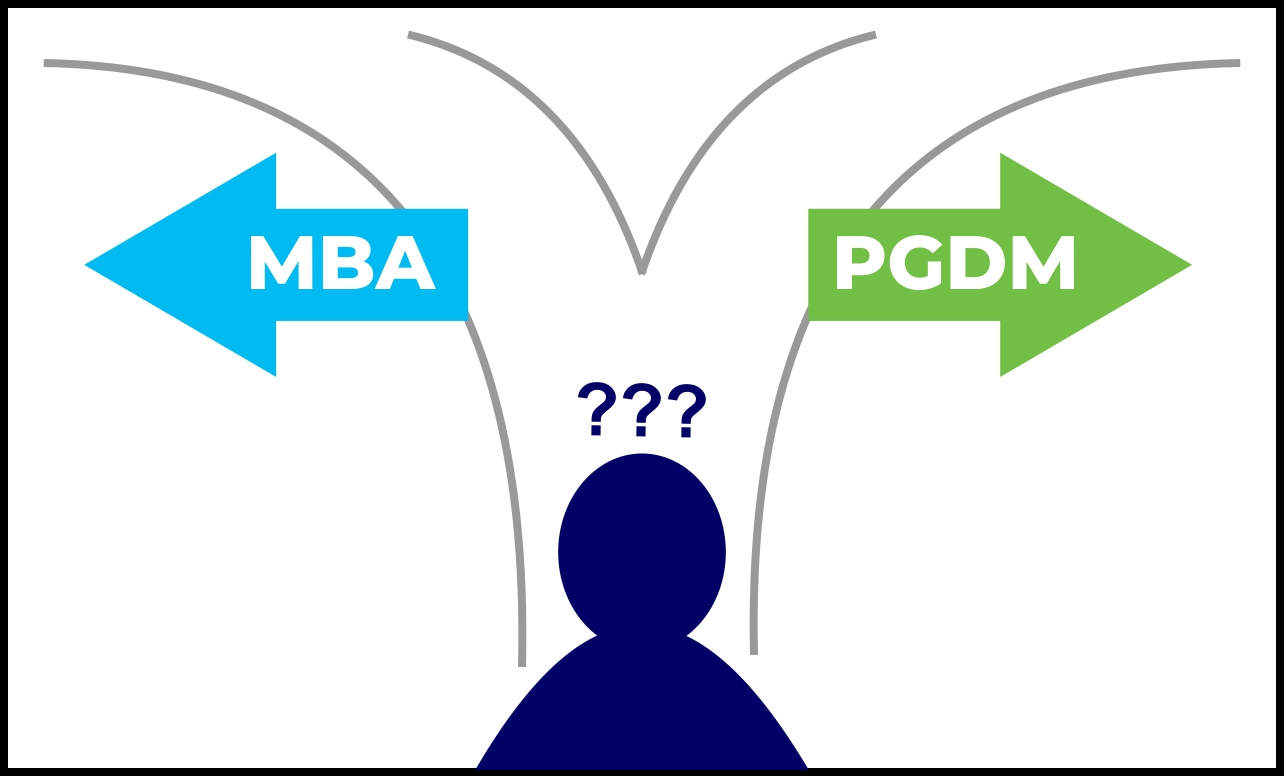
Which is better - MBA or PGDM?
The choice depends on your career goals, learning style, and the institution's reputation, with PGDM often offering a more industry-focused, practical approach (good for startups/tech/consulting) and MBA providing a structured, theoretical, university-backed path (better for academia/government/PhDs). Both hold similar weight in corporate hiring, but look for top-tier institutes like IIMs for either, as brand matters most, and consider PGDM for faster adaptability vs. MBA for formal structure.
What is the difference in fee structure?
The main fee difference is that MBAs, as they are from universities, are often cheaper due to government subsidies, while PGDMs are more expensive, as they are from autonomous institutes, costing more for better infrastructure, industry focus and updated curriculum, though top MBA programs (like IIMs) can also have very high fees. MBA fees might range from low lakhs to high lakhs, while PGDM fees usually start higher, from a few lakhs up to 30+ lakhs, depending on the institute's reputation and placement.
Key Points:
· MBA (University): Lower upfront cost, theoretical focus, government support.
· PGDM (Autonomous): Higher cost, practical/industry focus, autonomy in curriculum.
Exception: Top MBA programs (IIMs) defy the low-cost stereotype due to their autonomous status and elite branding, making their fees comparable to or even higher than many PGDMs.
What is the difference in Salary package after MBA and PGDM?
There is no substantial difference in salary packages based solely on whether you hold MBA degree or PGDM diploma. Instead, your salary package is primarily determined by the institution's reputation, your specialization, and the industry you enter.
Typical Salary Packages (Average Ranges)
While individual results vary, broad industry trends in 2025 show:
· Top-Tier Institutes (IIMs, XLRI, FMS, SPJIMR): Both programs offer similar high-end packages, typically ranging from ₹25 to ₹35 LPA.
· Mid-Tier Institutes: Salaries for both generally fall between ₹8 and ₹15 LPA.
· Entry-Level (General Average): Some sources suggest PGDM freshers may start slightly higher (approx. ₹12–15 LPA) compared to MBA freshers (approx. ₹7–10 LPA) because PGDM curricula often prioritize immediate industry-ready skill.
Which to Choose?
· Choose MBA for a strong academic foundation, broader recognition, and public sector roles.
· Choose PGDM for hands-on skills, industry relevance, and faster adaptation to market trends in corporate roles, especially from top institutes.
Note: For detailed information about MBA (Click Here) and PGDM (Click Here), Go for the link given.